
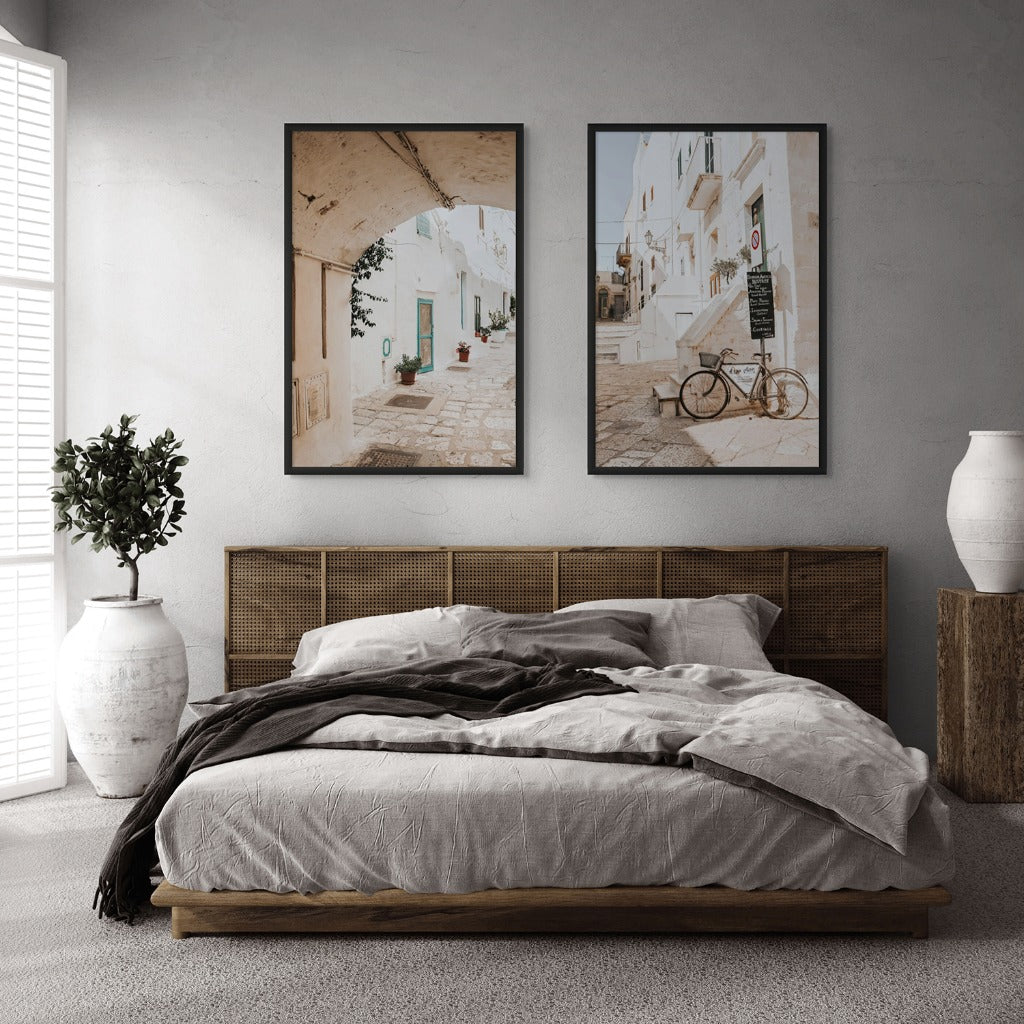
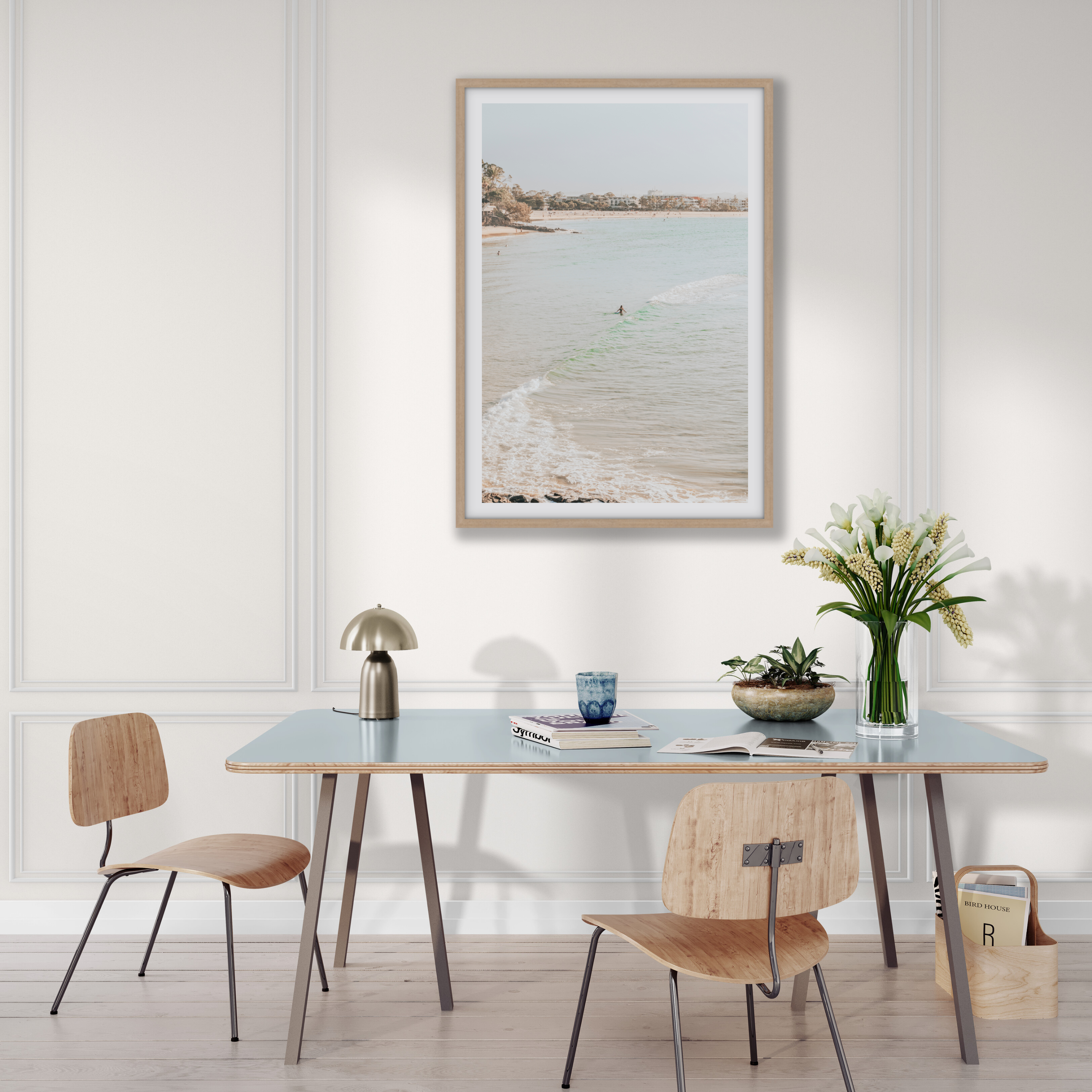
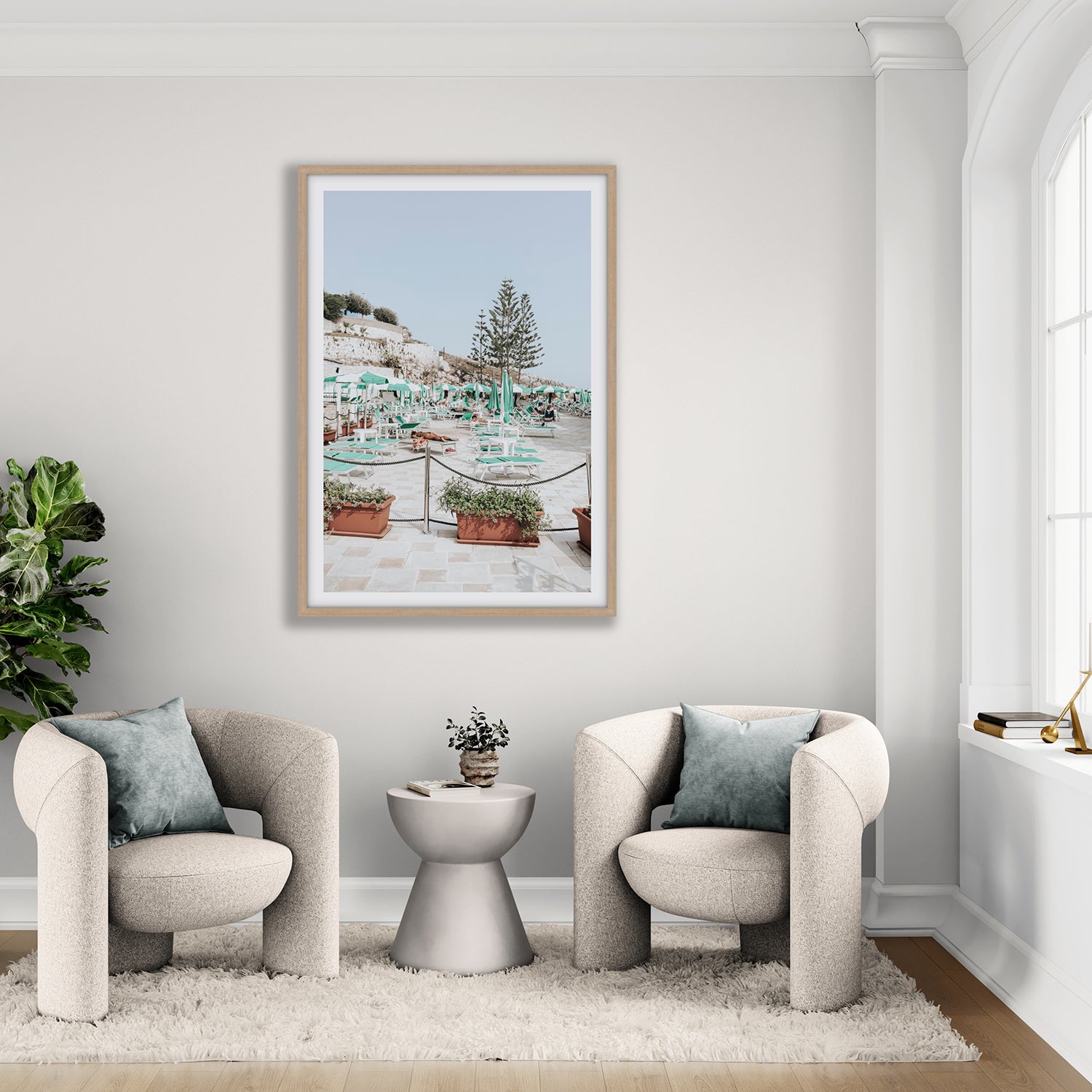
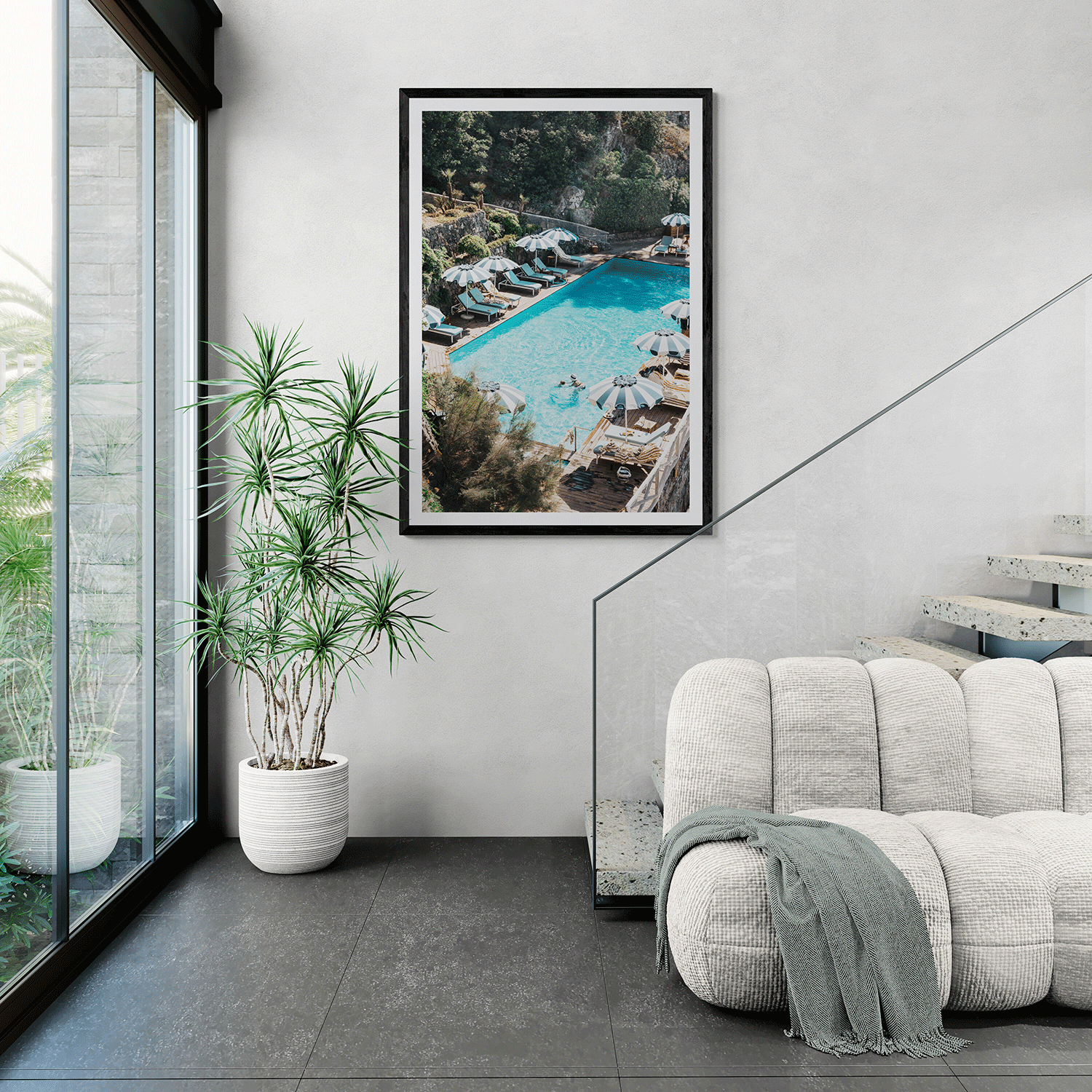

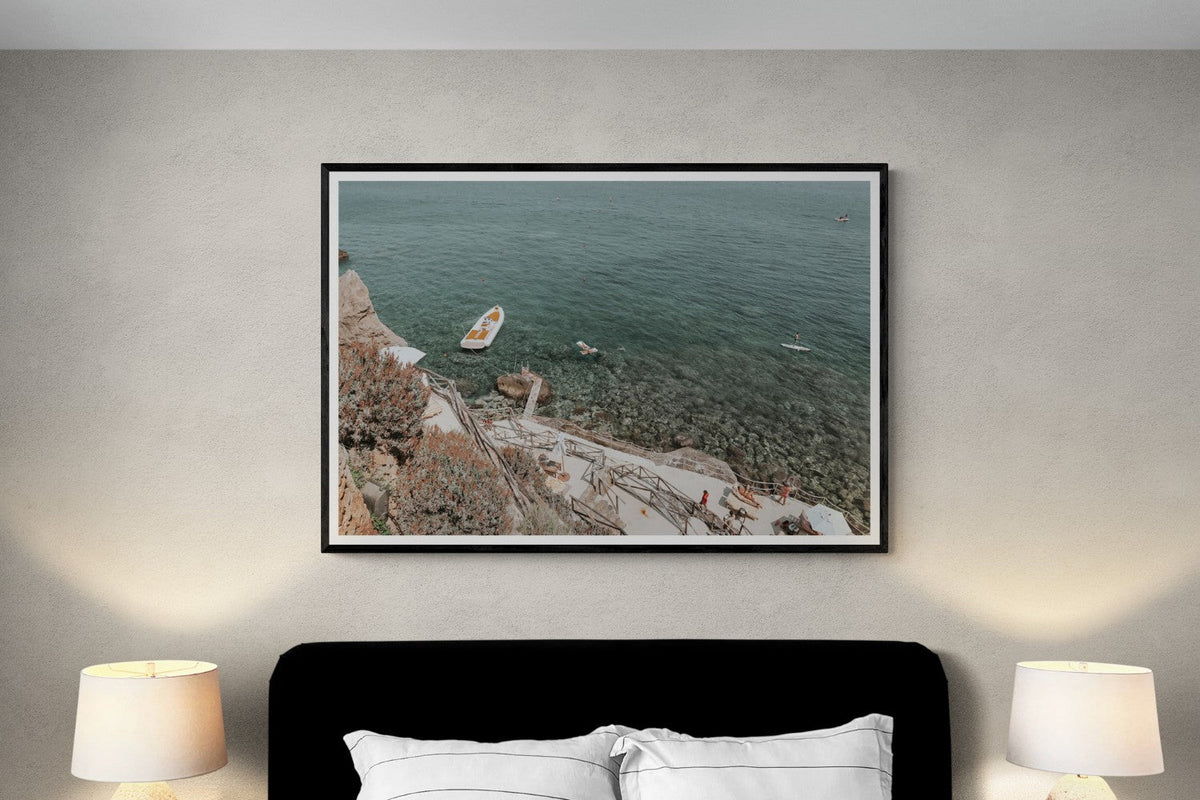

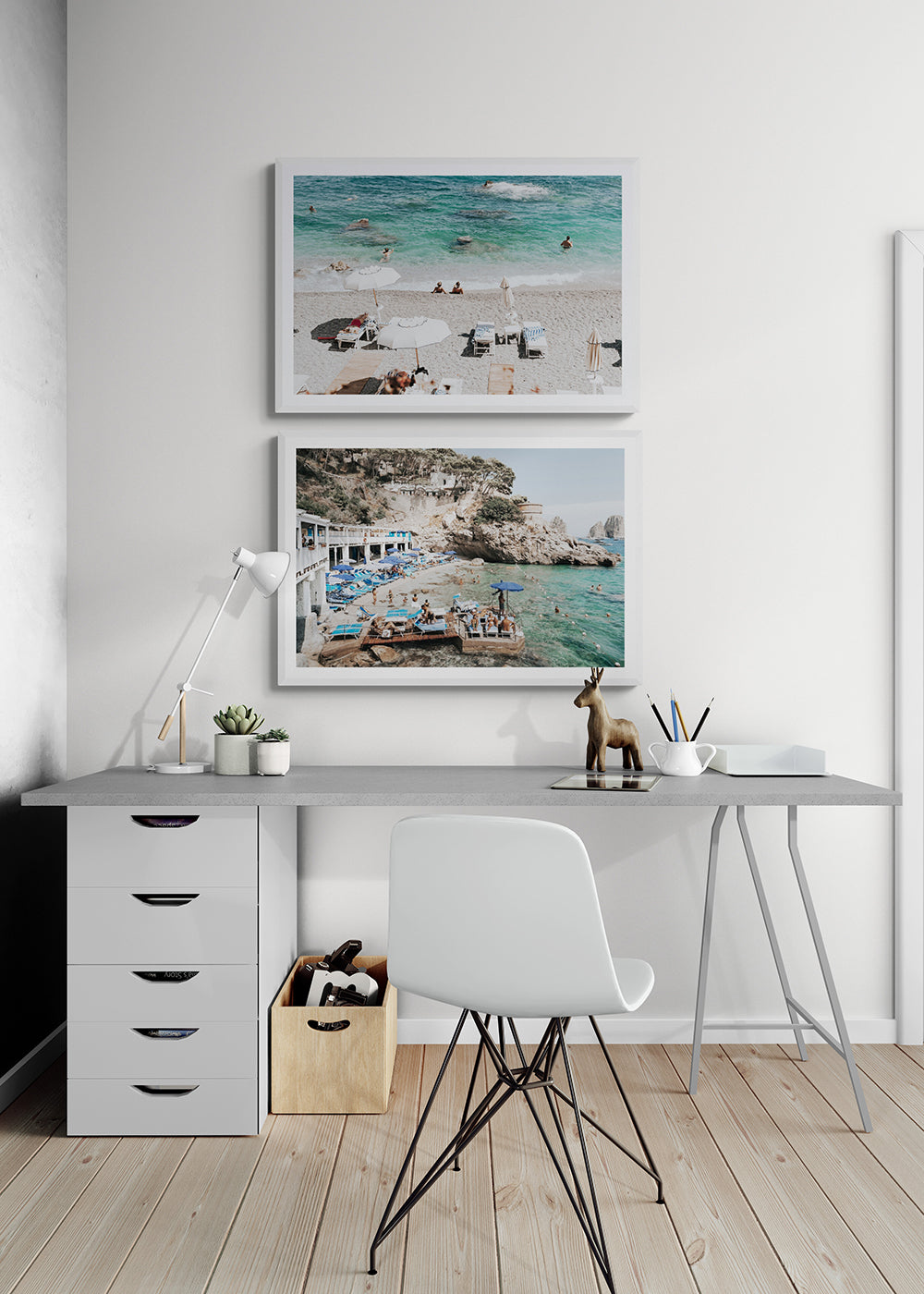

Artwork above a bed should generally span approximately 60–75% of the visible bed or headboard width. For an Australian queen bed around 153 cm wide, that means an artwork—or complete arrangement—approximately 92–115 cm wide.
Hang the bottom of the artwork around 15–25 cm or 6–10 inches above the headboard. Keep it centred over the bed rather than the entire wall, and use properly rated mechanical fixings suited to the artwork’s weight and the wall material.
These measurements are a starting point. The headboard, ceiling height and finished outer artwork dimensions can all change the best final size.
Use the 60–75% sizing rule
Measure the complete visible width of the bed or headboard, then multiply that measurement by 0.60 and 0.75.
Bed or headboard width × 0.60 to 0.75 = suggested artwork width
Use the total finished width of the framed artwork—not only the image printed inside it.
For a pair or group, measure the complete arrangement:
First frame + gap + second frame = total artwork width
The finished grouping should usually remain narrower than the headboard or bed so the two elements feel visually connected.
Australian bed and artwork sizes
Australian mattress dimensions vary slightly between manufacturers. These common widths provide a useful starting point, but a headboard or bed frame may be wider.
| Australian bed | Approximate mattress width | Suggested artwork width |
|---|---|---|
| Double | 138 cm | 83–104 cm |
| Queen | 153 cm | 92–115 cm |
| King | 183 cm | 110–137 cm |
| Super King | 203 cm | 122–152 cm |
Always measure the actual bed before ordering.
For Amichi Co landscape artwork in Australia, current finished widths include approximately:
- Extra Large: 96 cm
- Giant: 113 cm
- Gallery: 132 cm
- Statement: 150 cm
The exact height varies between Matboard, Full Bleed, Float Frame Canvas and Stretched Canvas presentations. Check the complete dimensions on the product page rather than selecting from the width alone.

Measure the headboard when it is wider than the mattress
The mattress provides a convenient standard measurement, but the visible furniture is what the artwork needs to balance.
Measure the headboard instead when it:
- extends well beyond both sides of the mattress;
- includes attached bedside panels;
- has prominent wings or posts;
- forms part of full-width joinery; or
- visually dominates the wall.
A queen mattress may be 153 cm wide, while its headboard could be 170 cm or more. Applying the sizing rule to the mattress alone could produce an artwork that looks too small against the actual furniture.
If the headboard is only slightly wider than the mattress, either measurement will provide a similar range. When the difference is substantial, use the headboard.
One large artwork or a pair?
Both can work above a bed. The right layout depends on the bed width, ceiling height and how calm or layered you want the bedroom to feel.
One large landscape artwork
A single landscape piece is the simplest way to echo the bed’s horizontal shape. It produces one focal point and avoids multiple frames directly above the sleeping area.
This is often the best option when:
- the headboard already contains detail or texture;
- the room has a calm, minimal direction;
- the artwork has enough scale to hold the wall;
- you prefer fewer visual elements; or
- the available wall height is limited.
For a queen bed, a finished artwork around 92–115 cm wide will usually sit within the suggested range. For an Australian king, begin around 110–137 cm.
Products such as The Lagoon show the finished dimensions for Matboard, Full Bleed and canvas presentations, making it easier to compare the complete footprint.
Two coordinated prints
A pair creates rhythm and can make a wide headboard easier to fill without requiring one very large artwork.
Keep approximately 5–10 cm or 2–4 inches between the frames. Include that gap when calculating the arrangement’s total width.
For example, two 50 cm frames with an 8 cm gap create a complete grouping 108 cm wide. That sits within the suggested queen range; for a king, use larger frames or a wider gap to reach the 110–137 cm starting range:
50 cm + 8 cm + 50 cm = 108 cm
That sits comfortably within the suggested range for many queen beds.
Choose two artworks that share a clear connection—location, colour, horizon, movement or mood—without looking like duplicates. The Amichi Co print sets provide ready-made pairings that can be assessed as one complete composition.

Three smaller artworks
A triptych or row of three can work well above a king or Super King bed, particularly when the wall is broad but not very tall.
Keep each gap consistent and relatively narrow. The arrangement should read as one unit rather than three separate pictures floating across the wall.
Three artworks introduce more visual activity than one large piece. Use a repeated frame finish, orientation or artwork palette to keep the result calm enough for a bedroom.
How high should art hang above a bed?
With a headboard, begin with 15–25 cm or 6–10 inches between the top of the headboard and the bottom of the artwork.
This distance keeps the artwork connected to the furniture while leaving enough separation for the headboard, cushions and bedding.
Move within that range according to the room:
- use the lower end when the ceiling is standard height and the artwork feels disconnected;
- use the upper end when the headboard is visually substantial;
- allow extra clearance if cushions rise above the headboard; and
- avoid lifting the artwork merely to fill a high wall.
The relationship with the bed is more important than applying a standard eye-level rule. Art above furniture often needs to sit lower than artwork on an empty wall.
What if there is no headboard?
Without a headboard, check real head and pillow clearance first. Sit upright in the bed with the pillows you normally use and mark the highest point your head or cushions reach. Place the bottom of the artwork comfortably above that line, then judge its visual relationship to the mattress from the doorway. Do not follow a fixed mattress-to-frame gap if it brings the artwork into the seated space.
Before fixing the frame, confirm that:
- the artwork clears upright pillows;
- someone sitting against the wall will not make contact with it;
- bedding can be changed without bumping the frame; and
- the composition still feels connected to the bed.
Painter’s tape is particularly helpful here. Mark the proposed outline and live with it for a day before installing anything.
If pillows change height regularly, position the artwork using the tallest usual arrangement rather than styling the bed unusually low for measurement.
Should the artwork be centred over the bed or wall?
Centre it over the bed or headboard in most bedrooms.
The bed is the visual anchor. If it is offset because of a doorway, wardrobe or window, centring the artwork on the wall can make it look misaligned with the furniture below.
There are exceptions. Built-in bedside joinery or a complete bed-and-table arrangement may form one wider composition. In that case, the artwork can respond to the full furniture grouping rather than the mattress alone.
Test the alignment from:
- the bedroom doorway;
- the foot of the bed; and
- the main path through the room.
Is landscape or portrait artwork better above a bed?
A landscape artwork is usually the easiest option because its proportions echo the bed.
Portrait pieces can still work when used as a pair or group. Two portrait artworks give the arrangement enough combined width while drawing the eye upwards.
Use:
- one landscape piece for a clear, calm focal point;
- two portraits for height and symmetry;
- two landscape pieces for a broad, cinematic arrangement; or
- three smaller works for a more layered wall.
A single portrait artwork above a king bed often looks too narrow unless the headboard is compact or the placement is deliberately asymmetrical.
Account for Matboard, Full Bleed and canvas
The same size name can have different finished heights across presentation options.
At Amichi Co:
- Matboard places visual space around the image and creates the tallest finished framed format;
- Full Bleed brings the image directly to the frame;
- Float Frame Canvas adds an outer frame and shadow gap; and
- Stretched Canvas has no external decorative frame.
When sizing the wall, always use the outer finished dimensions. For multiple artworks, use the same presentation throughout unless the difference is intentional.
How to test the size before ordering
Mark the complete outline
Use low-tack painter’s tape to mark the full framed dimensions above the bed. Do not mark only the image dimensions.
Check the view from the doorway
Artwork can look large when standing close to the headboard but undersized from the bedroom entrance. Check both positions.
Mock up every frame and gap
For a pair, outline the complete arrangement first. Then add the division between the frames. This makes it easier to judge the pair as one composition.
Photograph the wall straight on
A clear photograph allows you to compare artwork and sizes digitally.
Amichi Co’s Complimentary Styling Service can help you see a single artwork or print set in your room before choosing the final size and frame.

Hang artwork securely above a sleeping area
Artwork above a bed needs more than the correct proportions.
Use mechanical fixings selected for:
- the artwork’s complete weight;
- plasterboard, masonry, timber or the relevant wall construction;
- the fitted hanging hardware; and
- the number of attachment points required.
Do not assume an adhesive strip is suitable simply because it holds a lighter item elsewhere. Use the artwork’s supplied instructions and the fixing manufacturer’s load and wall-type guidance.
Larger or heavier pieces should be installed into suitable structural support or by an experienced picture hanger. If you cannot confirm what is behind the wall, arrange professional installation.
Amichi Co framed prints, Stretched Canvas and Float Frame Canvas arrive with professional hanging hardware selected for their size and format, but the wall fixings must still suit the specific wall.
Common mistakes above a bed
Choosing from the mattress name alone
A wide headboard can change the calculation. Measure the actual visible furniture.
Forgetting the frame and Matboard
Use the finished outer size, not only the printed image.
Hanging the artwork too high
A large empty gap makes the artwork look detached from the bed.
Ignoring the gaps in a pair
The spaces between frames contribute to the total width.
Using a small artwork to fill a large wall
The bed, not the wall, should establish the first size calculation.
Installing before testing
Tape and a digital mockup are easier to adjust than wall fixings.
Treating safety as an afterthought
Confirm the wall material, artwork weight and suitable hardware before installation.
See the scale before you decide
Explore the complete Amichi Co fine art print collection, checking each product’s finished dimensions rather than only its size name.
For personalised help, upload a straight-on bedroom photograph through the Complimentary Styling Service. Amichi Co can help compare a single artwork, pairing, size and frame before you order.
You can also see how the sizing principles apply in the living room in our guide to what size art should go above a sofa.
Bedrooms tend to suit quieter palettes — the soft and serene edit gathers calm, low-contrast pieces made for exactly this wall. For every size format, start with the artwork size guide.
Frequently asked questions
What size artwork suits an Australian queen bed?
For a queen mattress around 153 cm wide, begin with an artwork or complete arrangement approximately 92–115 cm wide. Measure the headboard instead if it extends substantially beyond the mattress.
What size artwork suits a king bed?
For an Australian king around 183 cm wide, aim for approximately 110–137 cm. For a Super King around 203 cm, begin around 122–152 cm.
How high should artwork hang above a headboard?
Begin with 15–25 cm or 6–10 inches between the top of the headboard and the bottom of the frame. Adjust for tall cushions, the headboard’s shape and the artwork’s height.
Is one large artwork or two prints better above a bed?
One large landscape piece creates the calmest focal point. A pair fills a wider space flexibly and can bring more movement to the room. Calculate the pair’s complete width, including the gap.
Can artwork be wider than the headboard?
It can be, but it is harder to balance. Keeping the artwork narrower than the headboard is the more reliable approach. Slightly wider artwork should look deliberate and respond to the complete furniture arrangement.
Is it safe to hang framed art above a bed?
It can be when installed using appropriately rated mechanical fixings suited to the artwork’s weight and wall construction. Use professional installation for large or heavy pieces whenever the correct support is uncertain.
Styling recipe
Three decisions that make the room feel finished

Start with mood
Choose the feeling first: calm, sun-washed, graphic or nostalgic. The right artwork should clarify the room before it asks for a decision.
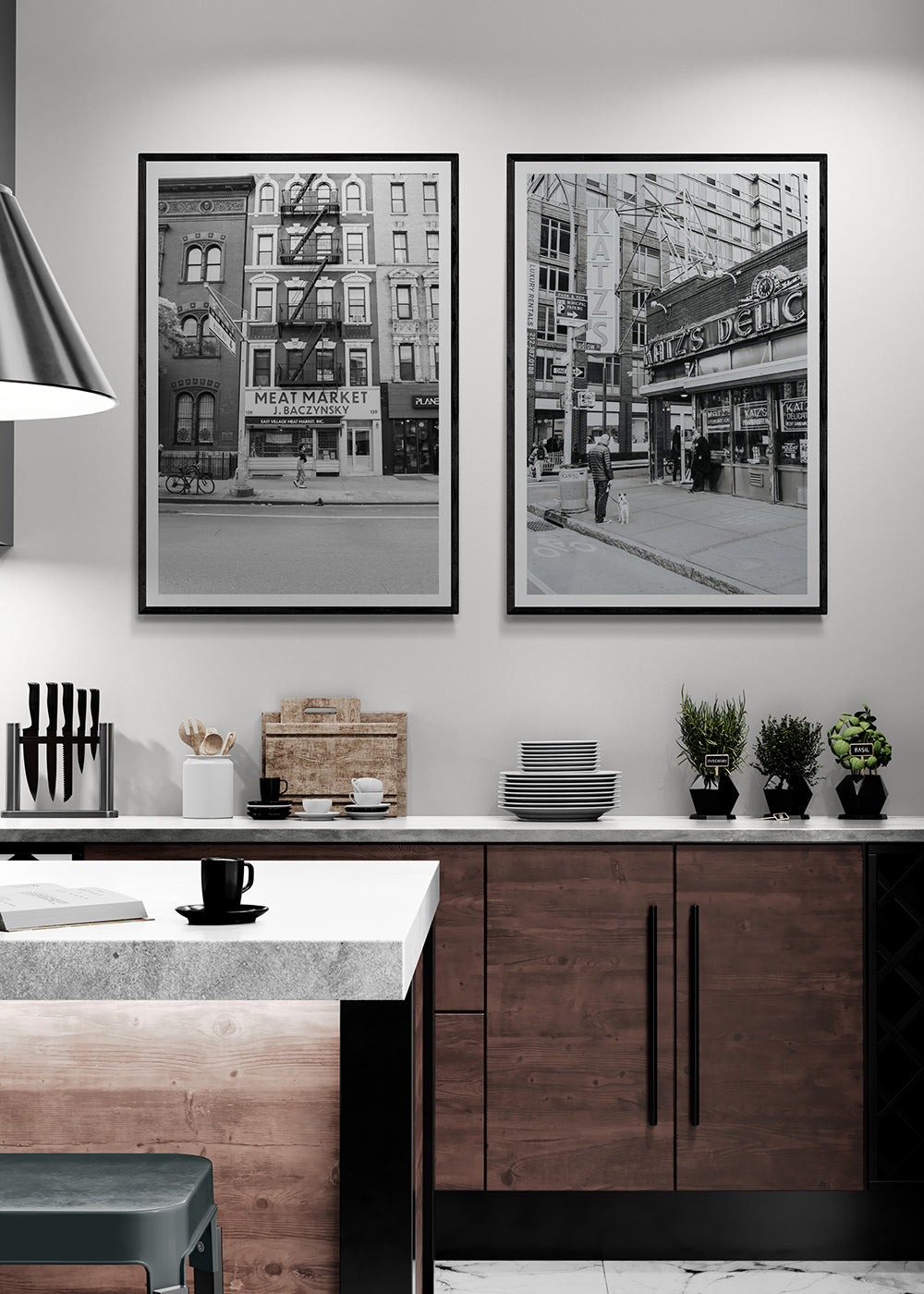
Build a pair
An artwork set can carry colour, subject or mood across the room and make the whole space feel more collected.

Choose the finish
The final edit should support the room: crisp and gallery-like for structure, softer and quieter for relaxed coastal spaces.